
Your skin already makes melatonin. We just give it more to work with.
Most people know melatonin as a sleep supplement. But human skin has its own melatonin receptors and produces melatonin independently — a localized system that actively protects against oxidative stress and environmental aggressors. Topical melatonin works with this existing system, delivering antioxidant support directly where your skin needs it.
Why topical application matters
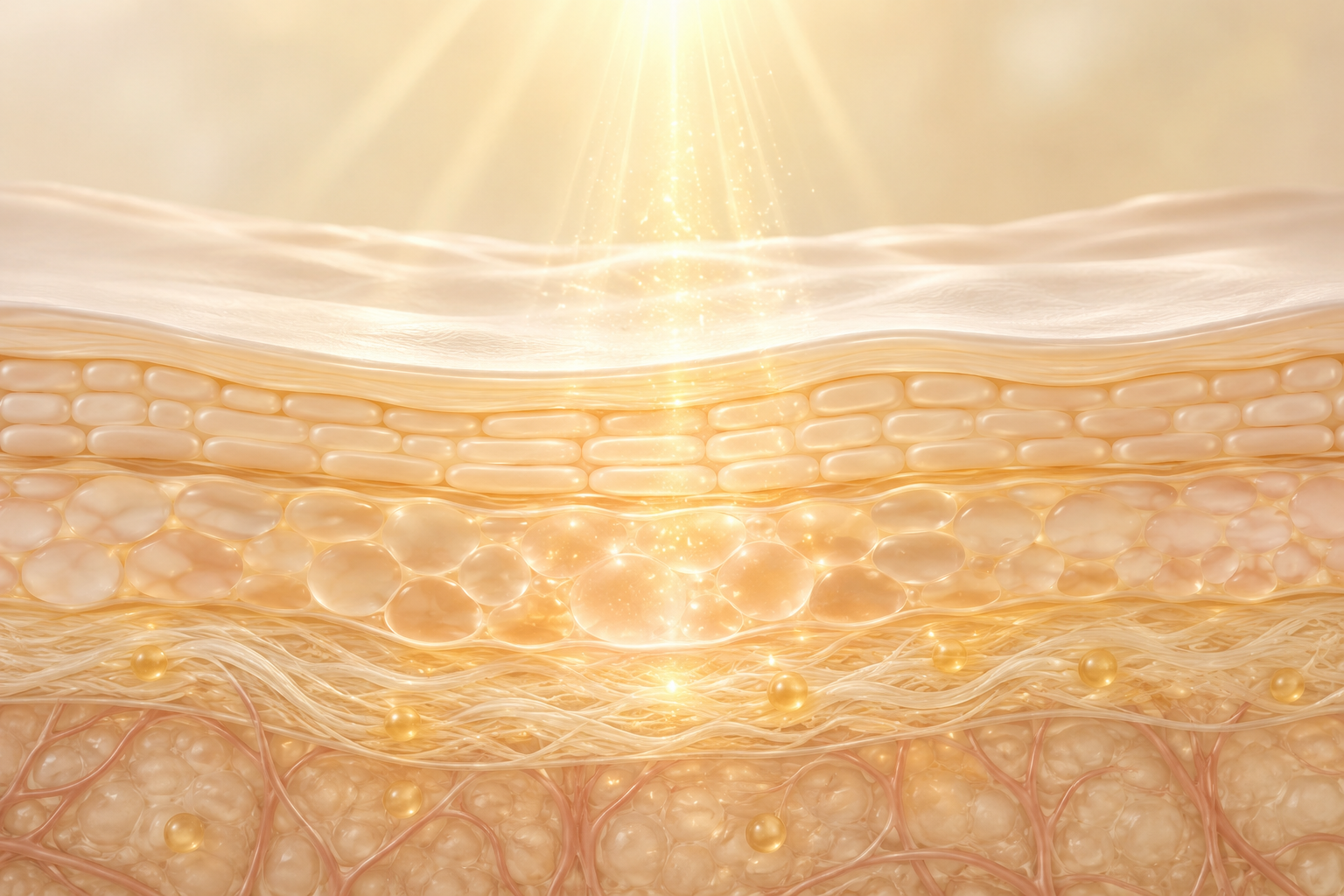
Oral melatonin loses most of its potency before it ever reaches the skin, broken down by the liver before it can act. Topical application bypasses this entirely — absorbing directly into the skin layers where melatonin receptors already exist. That's why we include it in every leave-on formula we make, and why you won't find it in rinse-off products. Contact time matters.
What the research shows
Melatonin as an antioxidant
Free radicals — generated by UV exposure, pollution, and daily environmental stress — are a primary driver of visible skin aging. As the body's outermost barrier, skin absorbs what everything else is shielded from.
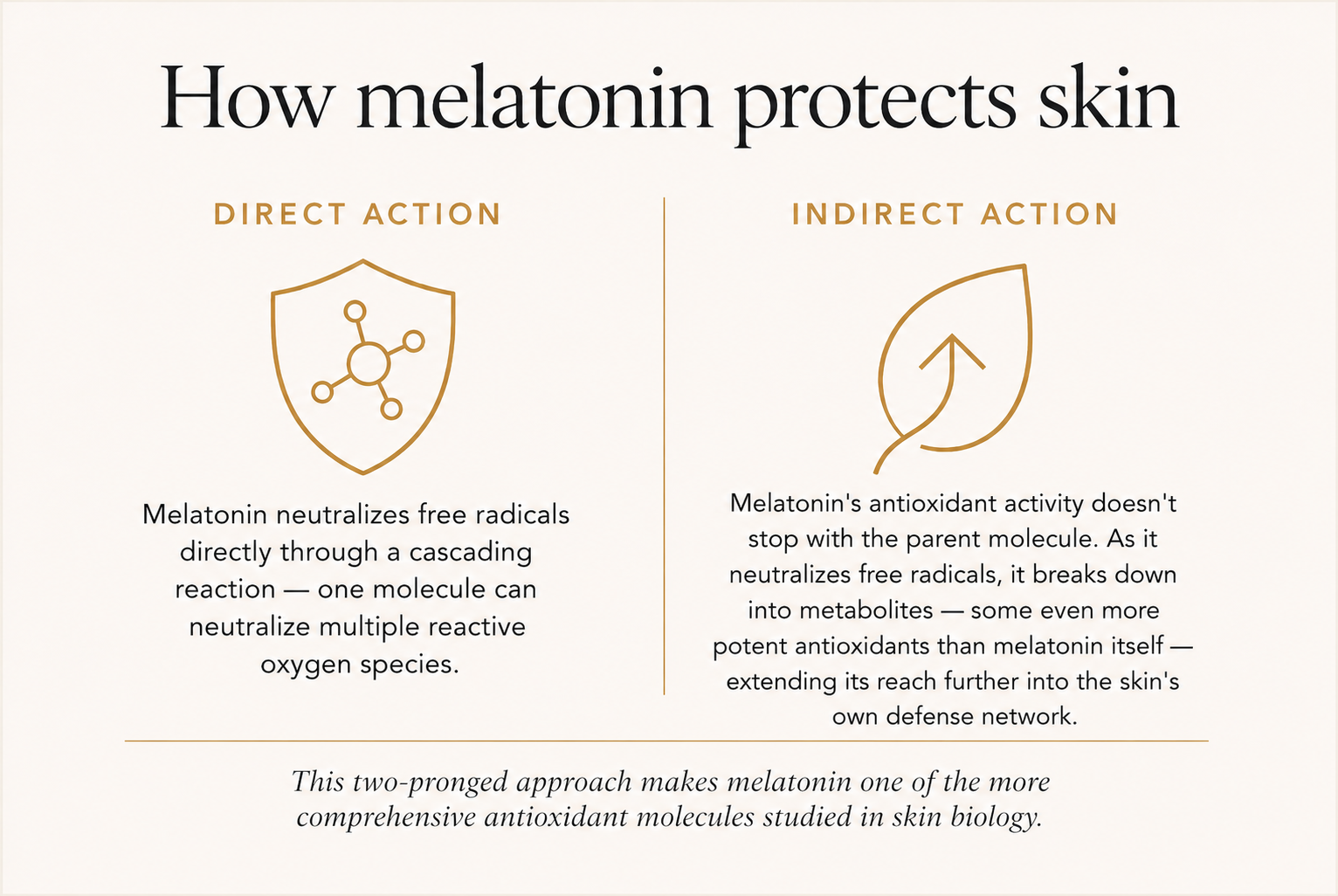
Melatonin neutralizes free radicals through a cascading reaction, meaning one molecule can neutralize multiple reactive oxygen species. Research suggests this cascading action helps support skin's own antioxidant defenses. The infographic below shows how it works.
Melatonin and Environmental Stress
Daily environmental exposure — sunlight, pollution, and everyday stressors — is one of the biggest contributors to oxidative stress in skin, and a major driver of visible aging over time.
Melatonin's cascading antioxidant action, covered above, is part of what makes it a compelling ingredient for helping skin cope with that kind of daily load. It's one of the reasons we consider it a foundational ingredient in every leave-on formula we make.
A note on sun protection: this page discusses melatonin's role as an antioxidant ingredient, not sun protection. Our products are not sunscreens and shouldn't replace one. For UV protection, always use a broad-spectrum SPF as part of your routine.
Skin Aging
Skin aging is driven by the same oxidative stress that UV exposure and other environmental factors accelerate — free radicals contributing to the breakdown of collagen and elastin over time. Melatonin's antioxidant properties make it a meaningful part of supporting skin's resilience against that process.
The skin's own melatonin production also decreases with age, which is part of why topical replenishment is worth considering as skin matures.
Clinical studies have shown improvements in skin hydration, tonicity, and the appearance of fine lines and wrinkles with topical melatonin use. The full picture of melatonin's role in skin aging is still developing — which is part of what makes this such an exciting area of skin science right now.
The skin's melatonin system
The skin doesn't simply receive melatonin from the bloodstream — it produces, metabolizes, and responds to it through its own localized system. Melatonin receptors exist throughout the skin's layers, and melatonin concentration in skin tissue is measurably higher than in plasma.
This system — what researchers call the cutaneous melatoninergic system — functions as an autonomous defense network, ramping up melatonin activity in response to environmental and oxidative stress. It even generates byproducts that are, in some cases, more potent antioxidants than melatonin itself.
This system weakens with age. Topical application is one way to support what the skin is already trying to do.
Why we use it
Kait came across melatonin's skin benefits through her work in holistic wellness and a deep dive into peer-reviewed research. What she found wasn't a trending ingredient or a marketing angle — it was a molecule with a serious and growing body of science behind it, and virtually no presence in clean skincare formulations.
So she formulated one herself.
We include melatonin in every leave-on product because we believe the research supports it, and because we think your skin deserves ingredients chosen for a reason.
You can read more about Kait and how the brand came to be on our About page.
Research References
The following peer-reviewed studies informed the content on this page. We encourage curious readers to explore them directly.
Rusanova I, et al. Protective Effects of Melatonin on the Skin: Future Perspectives. International Journal of Molecular Sciences. 2019. PubMed
Greco G, et al. Clinical Studies Using Topical Melatonin. International Journal of Molecular Sciences. 2024. PubMed
Day D, Burgess CM, Kircik LH. Assessing the Potential Role for Topical Melatonin in an Antiaging Skin Regimen. Journal of Drugs in Dermatology. 2018. PubMed
Slominski AT, et al. Melatonin and the Skin: Current Progress and Perspectives for Human Health. Journal of Investigative Dermatology. 2025. PubMed
Budiono CA, Anwar AI, Madjid A, Djawad K, Zainuddin AA, Rahman L. Unveiling the Anti-Aging Potential of Topical Melatonin: A Systematic Review. SKIN The Journal of Cutaneous Medicine. 2026;10(2):2966–2976. doi:10.25251/rf89pa05. Read the full study
Disclaimer
These statements have not been evaluated by the Food and Drug Administration. Tallow and Tonin products are cosmetic formulations and are not intended to diagnose, treat, cure, or prevent any disease. The melatonin used in our leave-on formulas is applied topically and is not intended for systemic use. Ingredient benefits and research referenced on this page reflect ongoing scientific investigation and general cosmetic use; they do not constitute medical claims. Individual results may vary. If you are pregnant, nursing, or under the care of a physician, consult your healthcare provider before use.